Your Cart
Total:
£0.00
 Zach Argyle
Table of Contents

Founder @ Jodana


When it comes to building high-quality backlinks, many agencies and marketers focus heavily on a single metric: Domain Authority (DA) or Domain Rating (DR).
This method has been used for years, and it’s not only outdated, it scams innocent marketers every day.
While DA/DR can be a helpful indicator of a website’s overall strength and trustworthiness, relying on it alone to determine backlink quality is dangerously misleading and significantly limits your SEO success.
DA and DR are the two easiest metrics to manipulate, misleading countless SEOs every day. We have case studies to prove it!
At Jodana, we developed a more comprehensive approach to link-building.
Our custom grading system evaluates backlinks across six key factors, weighted to a total of 100 points.
With 0 being the lowest a score can go, and 100 being the highest.
Our method ensures the backlinks you get are truly valuable.
Here is a breakdown of our multi-factor system and why it’s significantly better than using basic authority and traffic estimates.
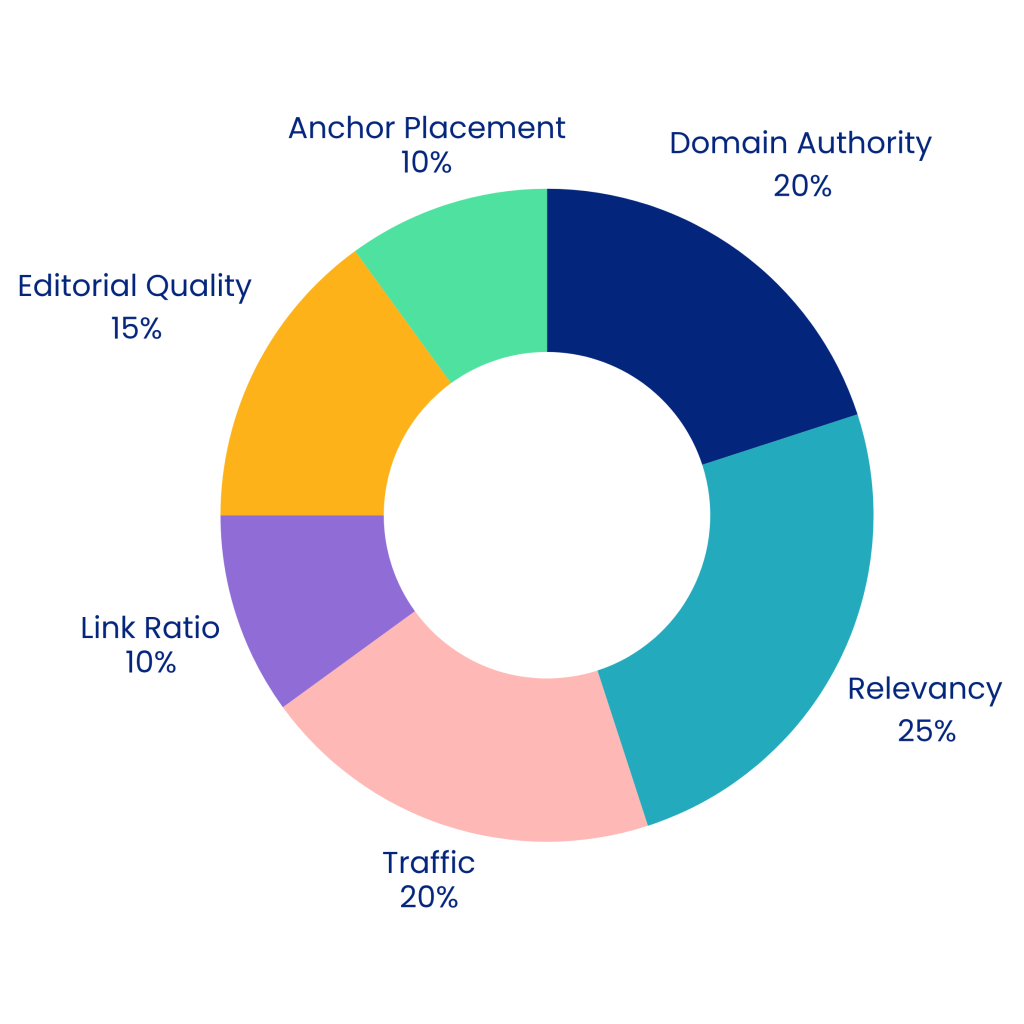
We score backlinks based on the following factors:
Authority remains an important metric in understanding the target website’s value.
It estimates the overall strength and trustworthiness of a website, indicating how likely it is to pass ranking power.
We include DA to filter out weak or spammy domains, but we don’t give more than 20% of the overall score due to its ease of manipulation.
Also, Google does not use DA or DR to calculate the value of a link. So why should we worry about it so much?
A site’s organic and direct traffic volumes reveal real user engagement.
High-traffic websites offer better referral opportunities and signal to search engines that the backlink is meaningful and valuable to actual users.
However, there is a nuance to this similar to domain authority.
Organic traffic is also easy to manipulate, which is why we allocate 20% of the overall score to it.
We consider traffic, but do not allow manipulation to hinder our scoring integrity.
Topical relevance is key for contextual SEO.
Backlinks from sites related closely to your niche reinforce thematic authority and improve ranking relevance.
Even a high-DA site can be less beneficial if its content has little relevance to your industry.
You can’t fake relevancy, nor can you manipulate it.
That’s why we have it as the most significant portion of our grading system.
This also means that you cannot give the same site the same score for a different niche.
For example, a beauty website will never get the same score as a car website for your automotive client.
A balanced ratio of outgoing to incoming links helps us avoid link farms or overly spammy sites.
Sites that excessively link out dilute their link equity and raise red flags with search engines.
Healthy link profiles typically have natural, measured link ratios.
We prioritise backlinks embedded within high-quality editorial content on websites with a real online purpose (beyond basic guest posts).
This factor helps ensure long-term trust and SEO value from the backlink.
90% of our Essential Backlinks are business websites managed by real people with real business models.
You can rest easy knowing that your links are not showing up on overpopulated blog and news websites.
Quality also includes the way the content is created and displayed on the site.
Elements like embeds, social shares, references to reliable sources and more are all included in our link value assessment.
Natural, contextually placed anchors reduce the risk of over-optimisation penalties.
Strategic anchor placement also shapes how search engines interpret the link’s relevance and intent, affecting how much SEO benefit is passed.
Before going into an example, it’s important to understand that we score our backlinks based on the specific client URL and backlink content.
Each client is different and some metrics won’t be the same as others (like relevancy).
We have a client www.gardenroomsupply.co.uk and we’re running a link-building campaign for them.
We find 2 different sites and we check all the initial metrics that are available to us (pre publishing):

These are very different websites, but could still be used in difference circumstances.
At first glance, we think “skinnedcartree.com is better”.
Why?
Because the DA and Traffic scores are significantly higher.
But those two metrics don’t tell the whole truth about the sites.
Say we look at the traffic estimates of skinnedcartree.com on Semrush and find that the traffic is irrelevant and doesn’t pertain to our client’s topic.
Then is that traffic really of any value? We don’t think so.
Also, we find that it’s DA/DR is predominantly from random high DA sites from Asia. It’s artificially inflating their metrics.
On the other hand, st-albans-garden-rooms.co.uk is very niche relevant, UK-based, business-backed, ranks for ‘garden room’ terms and has links directly from Facebook, Pinterest and other authoritative sites.
So in terms of ‘quality’, deeper analysis shows that st-albans-garden-rooms.co.uk is potentially a better link.
It might not have those ‘big 2 metrics’, but it excels in real quality metrics.
Lesson: DA and traffic metrics do not dictate quality.
But we don’t stop there, we dig even deeper.
We take anchor text, content quality, spam score and more into consideration as well. Just a few more metrics that can’t be faked to trick unsuspecting website owners.
Domain Authority, while popular, offers a narrow lens on backlink quality. Here’s why it’s not enough on its own:
By blending multiple important metrics, we ensure:
The Jodana Link Score will vary depending on the client website.
Why?
Think about this for a moment: Is a candy bucket website relevant for a construction company? No, but it is relevant for a birthday party website.
That means it will have a higher score for the birthday website without it ever changing anything strictly due to it’s relevancy (another flaw with DA/DR is its lack of recognising relevancy).
When ordering links through our site, you can expect an overall score of 50 – 75 for Essentials and 75 – 100 for Premiums.
Link building is both an art and a science, requiring more than a one-dimensional metric like Domain Authority.
Our grading system evaluates backlinks through a layered, nuanced lens, factoring in authority, traffic, relevance, link profile health, editorial integrity, and anchor optimisation.
This approach enables us to deliver backlinks that genuinely drive organic results, referral traffic, and brand reputation.
If you want link-building strategies built on robust, data-driven foundations, not shortcuts, our method provides the clarity and confidence you need to grow safely and effectively.